
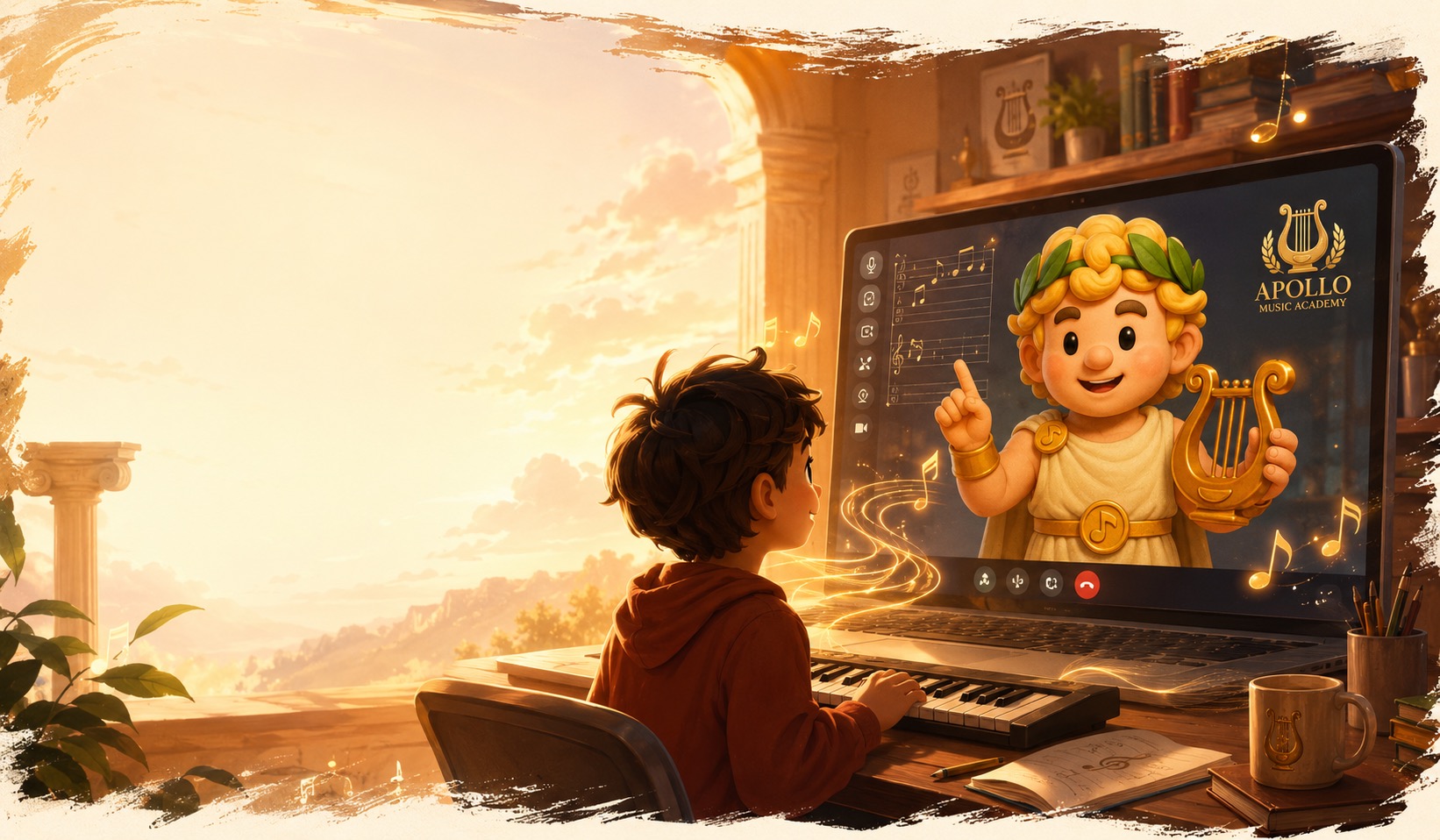
Live online music lessons for kids, with structure parents can trust.
Apollo online lessons bring piano, theory, foundations, and creative music learning into the home with live teacher feedback and clear practice direction.
Request an Online Trial
A low-pressure Apollo first step helps families understand fit before choosing the full pathway.
Start here PricingClear tuition before enrollment.
Review monthly lesson options, the $29 trial, registration, sibling registration, and the $100 family max.
View tuition QuestionsAsk Apollo for guidance.
Parents and directors can contact Apollo for placement, schedule, school partnership, billing, or program questions.
Contact ApolloMake it easy for the teacher to hear, see, and respond.
Online music lessons need more than a working video call. The teacher needs to observe the musical task, the student needs clear materials, and the family needs a simple way to solve setup problems. The best starting question is whether the actual instrument and activity can be taught clearly through your setup.
Prepare the lesson space
- Use a stable device position that shows the learner’s instrument and relevant movements. For piano, check that the teacher can see the hands and keys without the child holding the device.
- Keep the assigned score or activity visible without covering the video call. Prepare a pencil and any instrument required by your program.
- Check sound and connection before the appointment. Let the teacher hear a short sample and adjust the setup together; report missing or distorted musical sound.
- Agree on age-appropriate adult help and the approved meeting details. Keep access links private and contact Apollo through the usual channel if the connection fails.
Registration and payment do not authorize lesson recording or audio-to-text transcription. Before any such capture, Apollo will explain the specific use, what is created or retained, who can access it, and the storage and retention arrangements, and obtain the applicable separate permission. Without that permission, lessons continue with teacher-written notes at no extra charge. Read the recording and transcription requirements.
Four things to understand
Hear a clear model
The teacher demonstrates a short musical target and says what to notice, such as even beats or the end of a phrase. The student listens before attempting it.
Take musical turns
The student plays or responds while the teacher listens. Turn-taking gives the teacher a clearer chance to hear the individual result than trying to judge several overlapping sounds on a call.
Change one thing
The teacher identifies one useful correction, models if needed, and asks for another attempt. “Keep beat 3 silent” is more actionable than “do it better.”
Leave with a usable assignment
The family should know the exact passage or task, what to listen for, and what to do if it is too difficult. Use the assigned material rather than adding an unrelated video lesson.
An online rhythm exchange
The teacher counts four beats and claps on 1, 2, and 4. The learner takes a separate turn. If beat 3 accidentally receives a clap, the teacher points out that one event, demonstrates the silent beat, and invites a retry. Later, the learner tries the same task before another model. This small exchange reveals more than whether the child stayed on the call.
Make the next step visible
Distinguish a musical difficulty from a camera, sound, or connection problem. If the teacher cannot hear a note clearly, mark the evidence as unclear rather than recording an error. A short individual response, a later return, and a clear next step are useful signs of an instructional process.
Before you choose a next step
Yes for an instrumental program. Online Piano Pathway requires a piano or keyboard for lessons and home assignments. Apollo should confirm other program equipment before enrollment.
A family can submit an online preference, but Ashton must approve the actual private trial or lesson time and format. Online requests are not automatically confirmed appointments.
Agree on support appropriate to the student and program. A younger beginner may need help starting the call or arranging materials. Ask the child and teacher what assistance is useful, and avoid answering every musical question for the student.
Tell the teacher what is happening and use Apollo’s lesson-support channel. Do not treat an inaudible or disconnected attempt as evidence of low skill. Scheduling or service adjustments follow the applicable enrollment terms.
How this guide was prepared
Apollo Music Academy guide. Updated September 5, 2026. Educational examples are original Apollo guidance.
Research on musical models and parent involvement informs these teaching choices, but neither cited study compares Apollo online lessons with in-person lessons. Camera placement and connection checks are practical delivery requirements, not claims of an optimal technology setup.
- Cash and colleagues: model performances and skill acquisition (2014)
- Creech: Learning a musical instrument - parental support (2010)
Program eligibility, tuition, and enrollment terms are listed on the current program and tuition pages. Learning results vary and must be observed in the student’s work.
Ready to find the right Apollo path?
Start with a trial, review tuition, or contact Apollo so the next step feels clear.